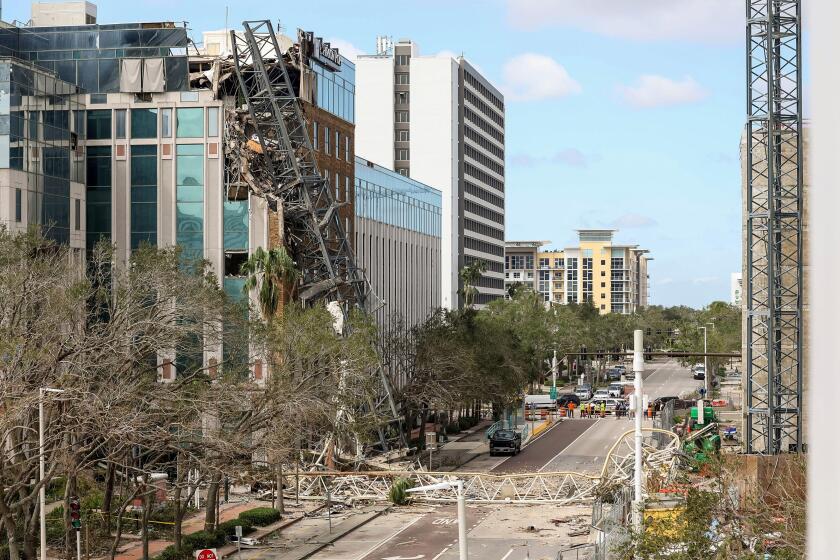
The (re)insurance market has avoided the worst-case scenario regarding Hurricane Milton, with a day-one post-landfall consensus building around a $40bn-$50bn loss, Insurance Insider US understands.
At this level, Milton would represent a reinsurance event contained enough to be manageable, but significant enough to scupper cat rate reductions. It is not expected to be a major retro or ILS event but will hit some ILWs and lower-layer retro.
Estimates are incredibly preliminary and based around a combination of judgement and early modelling, with scope for a large miss versus the ultimate loss. Claims information will take time to emerge, and Florida-heavy events are always susceptible to loss creep.
On Wednesday night, as Hurricane Milton was fluctuating between Category 4 and 5 strength in the Gulf of Mexico, sources feared a “market changing” event causing insured losses into the triple-digit billions.
An event of that magnitude would have destroyed the fragile and embryonic stability achieved in the Florida property market over the past 18 months, as well as throwing the sustainability of both the Florida Catastrophe Hurricane Fund (FCHF) and the National Flood Insurance Program (NFIP) into further question.
Milton, however, made landfall near Siesta Key at Category 3 strength, rather than 70 miles north in Tampa at Category 4 or 5 strength as had been projected in the worst-case forecasts – which would have generated insured losses well in excess of $100bn.
The storm surge was also less severe than the 15 ft that was predicted, at less than half that for large stretches of Florida’s west coast, partly because Milton hit at low tide.
As dawn broke over the Sunshine State and authorities began to survey the damage, a more optimistic picture of the loss began to emerge – although sources were clear that Milton will be a reinsurance event that will influence the direction of US and potentially even international cat pricing.
The event also serves as a harsh warning of the potential for an apocalyptic loss caused by a severe hurricane striking either Tampa or Miami, with two major storms – Helene and Milton – skirting the former metropolitan area within a fortnight.
It also leaves carriers exposed to significant sideways risk, with scope for further activity over the next few weeks before the active part of the storm season comes to an end.
Dodging the bullet
Sources expressed a sense of relief that Milton was not the mega-loss projected in some forecasters’ worst-case scenario models, which would have significantly exceeded 2005’s Hurricane Katrina (~$102bn inflation-adjusted) and become the highest insured property loss in history.
One source pointed out that the Lloyd’s realistic disaster scenario for a Cat 4 hit directly to Tampa would be an industry loss of around ~$200bn.
Multiple sources in the insurance and reinsurance segments are now guiding towards estimates of $40bn to $50bn for the ex-NFIP loss, although these are heavily caveated due to the early stage of the process.
Some sources likened Milton to 2022’s Ian, another hurricane that approached Florida from the west. The storm made US landfall at Category 4 strength in Cayo Costa, just 45 miles south of Milton’s entry point.
Milton’s loss will be slightly larger than that caused by Ian, but more manageable than previously expected, sources suggested, with Ian now pegged at ~$40bn – down on earlier estimates of $50bn-$60bn.
The difference this time, however, is the market correction that occurred between Ian and this year’s summer reinsurance renewals in Florida, sources stressed.
Now, the “cushion of premium” that reinsurers draw from Floridian cedants is much thicker than it was in 2022, one source said, making Milton a more easily affordable event for reinsurers.
The increased retentions on both Florida and nationwide cat programmes during the most recent renewal cycle will also reduce reinsurers’ cut of the ultimate insured loss.
Sources agreed that around the $50bn mark, Milton will be a reinsurance event but a digestible one, with the potential for the loss to nudge into the lower levels of some retro programmes.
One senior source said that well run, diversified businesses with reinsurance units should still be in a position to generate double-digit RoEs this year.
Impact on reinsurance market conditions
Even though Milton did not present the industry with the Armageddon scenario that it feared, sources noted the meaningful portion of premium that the loss will take from reinsurers’ coffers for the year.
“Discipline [among reinsurers] will be rediscovered,” as one source put it.
Others said the loss would at the very least stop potential 1 January rate reductions in their tracks and, if it creeps towards $60bn or beyond, contribute to further rate hardening next year.
The market view had previously pointed to expectations of a competitive cat treaty renewal, with some sources floating potential rate reductions of 5-10%.
A state of emergency
Even as a ~$50bn insured loss event, Milton will exacerbate existing structural challenges within Florida that have so far only partly been mitigated by various political interventions.
Years of successive hurricane losses have pushed nationwide insurers out of the state to an increasing degree, while the market share held by typically less capitalised Florida-specific companies has grown.
As shown in the table below, Floridian insurers have suffered reductions in policyholders’ surplus after a number of major hurricanes including Irma, Michael and Ian, illustrating the strain that large-scale storms put on local carriers.
At the same time, the struggles of the various state-sponsored efforts to alleviate pressure around primary insurance prices and availability are thrown into sharp relief by Milton.
The FHCF, which attaches at $10bn but at present has only around $6bn in claims-paying resources, will obviously face a degree of challenge and likely reform following the hurricane.
Meanwhile the NFIP, which Gallagher Re predicted pre-landfall would pick up a “mid to high single-digit-billion impact” from Milton, has its own woes.
As highlighted by AM Best in a recent report, the NFIP carries around $21bn in debt and will likely be burdened with more following Milton and Helene.
The NFIP’s last multi-year reauthorisation expired in September 2017 and, in a disruptive sequence of events, has since been granted 30 short-term extensions by the US Congress, including three lapses.
The additional burdens brought about by Milton and Helene will only add to the angst around the NFIP.
The Big One is still out there
Sources were universal in their relief that Milton changed its course and weakened in the final hours of its Florida approach – but all stressed how close the industry came to “The Big One”.
The early telegraphing from reinsurers is that their portion of the loss will be manageable, and that Milton vindicates their work to lift retentions and shift their participation further out on the risk curve.
But should Milton have taken the worst-case track and maintained its strength, the (re)insurance industry would have been looking at a capital rather than earnings event – and constructing a very different narrative.